
Keder Systems Explained: A Core Component for Tensile Structures
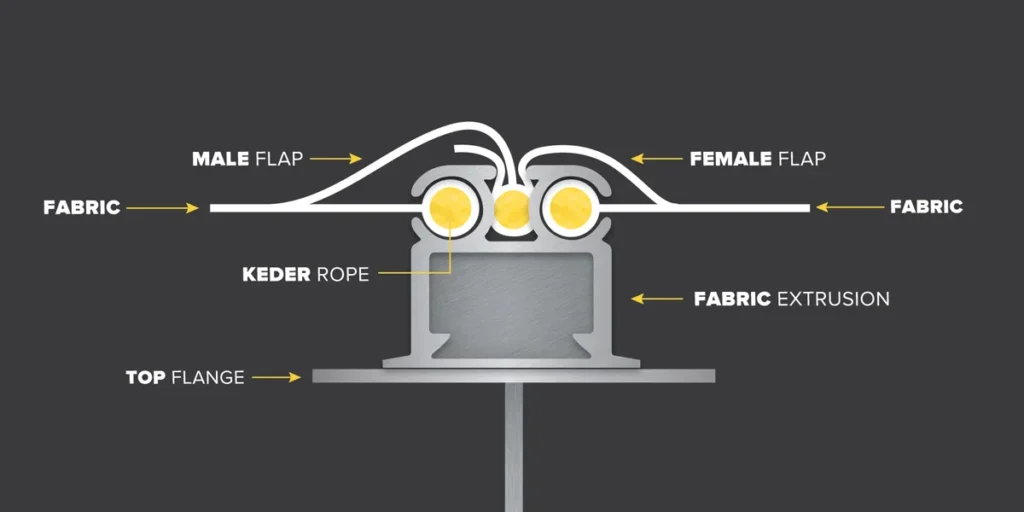
What is a Keder?
Keder, derived from the German word “köder,” refers to a specialised extruded or moulded flexible profile, and essentially the fixtures used to secure the fabric. It typically consists of a solid core, usually made of PVC or other durable materials, such as EPDM, enclosed by a fabric covering. This fabric covering can be a part of the tensile membrane or a separate layer specifically designed for Keder attachment. The Keder’s core is shaped so that it can slide or fit into a corresponding track or groove, enabling it to be securely attached to the supporting structure.
It consists of:
- A high-strength fabric edge
- A PVC or reinforced polymer cord (often called the Keder rope)
- Precision welding or stitching that permanently bonds the cord to the membrane
The cord slides into a specially designed track, creating a secure mechanical connection without puncturing the fabric.
Think of it as the “anchor” that keeps the tensile membrane firmly connected to the supporting structure while maintaining the correct tension.
The Role of Keder in Tensile Fabric Architecture
Keder acts as a strong anchor for the fabric in the supporting structure. It is commonly attached to structural elements such as aluminium or steel profiles, creating a secure connection between the fabric and the framework. This connection ensures that the fabric remains taut and stable, even under various environmental conditions such as wind or snow.
Tensile fabric architecture often requires protection from the elements, including rain, wind and UV radiation. The Keder also acts as a sealing mechanism between the membrane and the supporting structure, preventing water ingress and air leakage. This tight seal helps maintain a comfortable and weather-resistant environment within the structure.
Keder offers flexibility in design, enabling architects and designers to create complex, curved and customised fabric structures. The ability of the Keder to move within the track allows for easy installation, adjustments, and removal, making it an efficient solution for temporary or semi-permanent structures.
The Keder also helps to distribute the tensile forces evenly along its length, reducing stress concentration points on the fabric membrane. This feature is especially important in large-scale tensile structures, where load distribution plays a critical role in maintaining structural integrity.
While primarily a functional component, Keder can also contribute to the visual appeal of tensile fabric architecture. It offers a seamless transition between the fabric membrane and the supporting structure, creating a clean and visually pleasing appearance. The discreet nature of the Keder allows the fabric to take centre stage, highlighting its sculptural qualities and artistic design.
Why Is Keder So Important?
Although it occupies only the edge of the membrane, the Keder performs several critical functions.
It helps:
- Secure the membrane firmly
- Distribute tension evenly
- Resist wind uplift
- Prevent fabric slipping
- Improve waterproofing
- Reduce stress concentration
- Simplify membrane replacement
- Enhance overall structural stability
Without a properly designed Keder system, the membrane cannot perform as intended.
Advantages of Using Keder Systems
1. Uniform Load Distribution
One of the biggest advantages of a Keder system is that it spreads tension evenly across the membrane.
This minimizes localized stress points that could otherwise lead to tears or premature wear.
2. Stronger Wind Resistance
India experiences strong seasonal winds, especially during the monsoon.
A properly engineered Keder system helps keep the membrane securely attached, reducing the risk of movement or damage.
3. Better Waterproof Performance
Since the membrane isn’t punctured with numerous fasteners, there are fewer opportunities for water leakage.
This creates a cleaner, more weather-resistant roofing system.
4. Clean Architectural Appearance
Keder systems are largely concealed within their tracks, giving tensile structures a sleek and modern finish without exposed hardware.
This is one reason tensile architecture is so visually appealing.
5. Easier Maintenance and Replacement
If a membrane eventually needs replacement after many years of service, the Keder system allows it to be removed and reinstalled more efficiently than many traditional fastening methods.
This can reduce maintenance time and future replacement costs.
Why Proper Installation Matters
Even premium Keder components cannot compensate for poor installation.
Improper installation can result in:
- Uneven membrane tension
- Fabric wrinkles
- Water pooling
- Edge damage
- Reduced wind resistance
- Premature membrane wear
This is why engineering accuracy and installation expertise are just as important as material quality.
At Archilexis, every membrane is fabricated and installed with precise tension calculations to ensure long-term structural performance and aesthetic excellence.
Why Choose Archilexis?
At Archilexis, we believe exceptional tensile architecture is built on engineering excellence—not just appearance.
Every project incorporates carefully selected materials, precision fabrication, and professionally installed Keder systems to ensure reliable long-term performance.
Our expertise includes:
- Car parking tensile structures
- Commercial entrance canopies
- Walkway covers
- Swimming pool shades
- Industrial tensile roofing
- Hotel and resort structures
- Sports facilities
- Educational campus canopies
- Custom architectural tensile solutions
From design to installation, our focus is on creating structures that are durable, visually impressive, and built to withstand India’s diverse climatic conditions.
While the fabric membrane and steel framework often receive most of the attention, the Keder system is one of the most important components in a tensile membrane structure.
It securely connects the membrane to the supporting frame, distributes loads evenly, improves waterproofing, enhances wind resistance, and contributes significantly to the structure’s long-term durability.
Whether you’re planning a commercial canopy, industrial roofing system, or architectural tensile structure, ensuring the Keder system is professionally designed and installed is essential for lasting performance.
With Archilexis, every detail—from the membrane to the Keder connection—is engineered to deliver reliability, safety, and architectural excellence.
Frequently Asked Questions (FAQs)
1. What is a Keder in a tensile membrane structure?
A Keder is a reinforced edge connection consisting of a high-strength cord welded to the membrane. It slides into an aluminum or steel track to securely attach the tensile fabric to the supporting structure.
2. Why is Keder important?
The Keder system distributes tension evenly, improves wind resistance, enhances waterproofing, prevents fabric slippage, and increases the overall lifespan of the tensile structure.
3. Can a tensile structure work without a Keder system?
Some specialized designs use alternative edge fastening methods, but modern tensile membrane structures commonly rely on Keder systems because they provide a cleaner appearance, stronger attachment, and more efficient load distribution.
4. Does the Keder affect the lifespan of the membrane?
Yes. A properly designed and installed Keder system reduces stress on the membrane, helping prevent premature tears, edge damage, and uneven loading, which contributes to a longer service life.
5. Is Keder waterproof?
The Keder itself is part of a waterproof edge system. Since it avoids excessive puncturing of the membrane with mechanical fasteners, it helps maintain the structure’s resistance to water penetration.
6. Can the membrane be replaced without changing the entire structure?
In many cases, yes. One advantage of Keder systems is that the membrane can often be removed and replaced while retaining the existing structural framework, provided it remains in good condition.
7. Where are Keder systems commonly used?
They are widely used in car parking canopies, walkway covers, stadium roofs, swimming pool shades, hotels, shopping malls, industrial facilities, airports, sports complexes, and many other tensile membrane applications.
8. Why choose Archilexis Tensile for tensile membrane projects?
Archilexis Tensile combines precision engineering, premium membrane materials, high-quality Keder systems, and expert installation to deliver tensile structures that are durable, low-maintenance, and architecturally impressive.