
Why Tensile Structures Are Better Than Traditional RCC Roofs?
Our commitment to quality and exceptional customer service sets us apart from the competition.
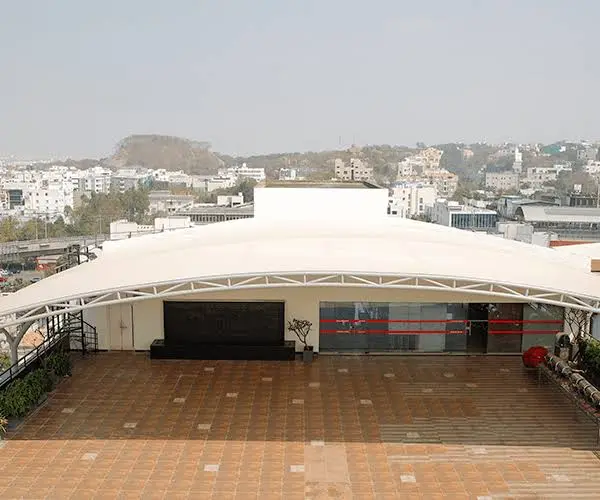
1. Much Faster Installation
Additionally, one of the biggest advantages of waterproof tensile fabric is speed.
An RCC roof involves:
- Foundation work
- Steel reinforcement
- Concrete pouring
- Curing
- Waterproofing
- Finishing
This process can take several weeks or even months.
A tensile structure, on the other hand, is largely fabricated off-site. Once the steel framework and membrane are ready, installation is significantly faster, minimizing disruption and reducing labor costs.
For businesses that cannot afford long construction delays, tensile structures are often the preferred solution.
2. Lightweight Yet Extremely Strong
Concrete roofs are incredibly heavy.
This means:
- Larger foundations
- Bigger columns
- Higher structural costs
- Increased seismic loads
Tensile structures are designed to be lightweight, and waterproof tensile fabric adds exceptional strength.
Because the overall dead load is much lower, they reduce stress on the building and often require less supporting infrastructure.
This makes them particularly suitable for retrofitting existing buildings where adding an RCC roof may not be structurally feasible.
3. Stunning Modern Architecture
Appearance matters.
Whether it’s a luxury hotel, shopping mall, corporate office, or residential township, first impressions influence customer perception.
Traditional RCC roofs generally offer limited design flexibility.
Tensile structures, however, can be engineered into:
- Wave forms
- Cones
- Hypar designs
- Barrel vaults
- Butterfly roofs
- Sail-inspired canopies
- Free-form architectural designs
These distinctive shapes create iconic landmarks that enhance property value and brand image.
4. Cost-Effective for Large Span Areas
Large open spaces such as:
- Parking lots
- Stadiums
- Industrial yards
- Public plazas
require wide spans without intermediate columns.
Creating these spans using RCC often demands massive beams and extensive reinforcement, increasing both material and labor costs.
Tensile structures can efficiently cover large areas with minimal support, making them a more economical solution for many commercial and institutional projects.
5. Better Natural Lighting
Architectural tensile membranes allow diffused natural daylight to pass through.
Benefits include:
- Reduced electricity consumption
- Improved visibility
- Better user comfort
- Lower daytime lighting costs
Unlike RCC roofs, which completely block sunlight, tensile roofs create bright, naturally illuminated spaces without excessive heat when high-quality membranes are used.
6. Lower Maintenance Requirements
Modern tensile membranes are designed to withstand:
- UV radiation
- Heavy rainfall
- Wind loads
- Dust
- Pollution
- Fungal growth
Many premium membranes also feature self-cleaning properties that help maintain their appearance over time.
In comparison, RCC roofs often require periodic waterproofing, crack repairs, repainting, and maintenance to prevent seepage and deterioration.
7. Excellent Weather Resistance
India experiences diverse weather conditions, including:
- Intense sunlight
- Heavy monsoons
- High humidity
- Strong winds
- Dust storms
High-quality tensile membranes are engineered to perform reliably in these environments while maintaining structural integrity and appearance.
Proper engineering ensures excellent drainage, preventing water accumulation that commonly affects flat RCC roofs.
8. Environmentally Friendly Construction
Sustainability is becoming a priority in modern construction.
Tensile structures contribute by:
- Using less raw material
- Reducing embodied carbon
- Lowering transportation requirements
- Allowing greater natural daylight
- Reducing structural steel requirements in many applications
Many architectural membranes are also recyclable, making tensile structures a more environmentally responsible roofing solution.
9. Greater Design Flexibility
Architects love tensile structures because almost every project can be custom designed.
Whether you need:
- A premium entrance canopy
- A designer car parking shade
- A school walkway cover
- A resort pool canopy
- An airport-inspired roof
the structure can be tailored to match the architecture of the building rather than forcing the building to conform to the roof.
10. Increased Property Value
Premium architectural features attract attention.
A beautifully designed tensile roof can significantly improve:
- Brand perception
- Visitor experience
- Customer confidence
- Property aesthetics
- Commercial value
For hotels, malls, hospitals, and corporate campuses, investing in modern tensile architecture often enhances the overall appeal of the property.
Common Applications of Tensile Structures
Tensile structures are ideal for:
- Car Parking Shades
- Commercial Building Entrances
- Residential Society Parking
- Walkway Canopies
- Hotel & Resort Canopies
- Swimming Pool Covers
- Restaurants & Cafes
- Industrial Warehouses
- School Campuses
- Colleges & Universities
- Hospitals
- Petrol Pumps
- Airports
- Metro Stations
- Sports Arenas
- Event Spaces
- Amphitheaters
- Rooftop Lounges
Why Businesses Across India Are Choosing Tensile Structures
Businesses today seek roofing systems that are not only functional but also visually impressive.
A well-designed tensile structure offers:
- Faster project completion
- Premium architectural appeal
- Long-term durability
- Efficient use of space
- Lower maintenance
- Modern engineering
- Better return on investment for many large-span applications
These advantages have made tensile architecture a preferred choice for commercial developments throughout India.
Why Choose Archilexis Tensile?
At Archilexis Tensile, we specialize in designing and executing custom tensile membrane structures that combine engineering precision with architectural elegance.
Our solutions are tailored for:
- Commercial projects
- Residential developments
- Hotels & Resorts
- Industrial facilities
- Educational institutions
- Public infrastructure
- Retail spaces
From concept design and structural engineering to fabrication and installation, our team focuses on delivering durable, aesthetically striking tensile solutions that meet project requirements and industry standards.
Whether you’re planning a parking canopy, entrance structure, walkway, or a large-span roofing project, our goal is to create roofing systems that are functional, visually impactful, and built to last.
Frequently Asked Questions (FAQs)
Are tensile structures stronger than RCC roofs?
Tensile structures are engineered differently from RCC roofs. While RCC relies on mass and compression, tensile structures use high-strength materials working in tension. For many large-span roofing applications, tensile structures provide an efficient and durable solution when properly designed.
How long do tensile structures last?
Depending on the membrane material and maintenance, high-quality tensile structures can have service lives ranging from 15 to 30 years or more.
Are tensile roofs waterproof?
Yes. Modern architectural membranes are designed to be waterproof and are installed with drainage systems that efficiently channel rainwater.
Are tensile structures suitable for Indian weather?
Yes. High-quality tensile membranes are designed to withstand India’s varied climate, including heavy rainfall, strong sunlight, wind, and dust, when engineered for local conditions.
Is a tensile structure cheaper than an RCC roof?
For large-span applications, tensile structures are often more economical because they require less structural support and can be installed more quickly. The overall cost depends on project size, design complexity, materials, and site conditions.
Can tensile structures be customized?
Absolutely. Tensile roofs can be designed in various shapes, colors, and configurations to complement residential, commercial, institutional, and industrial architecture.
Which fabric is best for tensile structures?
Common materials include PVC-coated polyester, PTFE-coated fiberglass, and ETFE membranes. The best choice depends on the project’s lifespan, budget, environmental conditions, and design requirements.
Do tensile structures require maintenance?
Routine inspections and occasional cleaning are generally sufficient. Compared with many conventional roofing systems, maintenance requirements are relatively low.
To be completely honest, Traditional RCC roofs continue to serve many construction needs, but modern projects increasingly demand roofing systems that are lighter, faster to install, visually distinctive, and more adaptable. Tensile structures meet these expectations by combining advanced engineering with architectural freedom.
Whether you’re developing a commercial complex, hotel, residential society, educational campus, industrial facility, or public space, a professionally designed tensile structure can provide long-term value while enhancing the overall appearance of your property.
If you’re considering a tensile roofing solution for your next project, Archilexis Tensile offers custom-designed structures that balance aesthetics, durability, and functionality to suit a wide range of applications across India.